

Is Chip Development Is Fundamentally Different from Software?
A software bug can be patched. A chip bug can cost €5-18M and a year of delay.
Many of us have been shaped by the software world.
A bug becomes a patch. A missing feature becomes an update. A security issue becomes a new release. Modern technology has conditioned us to think that products can be continuously improved after deployment.
Semiconductors operate under a very different set of rules.
Over the coming months, we’ll explore what happens behind the scenes of modern semiconductor development: why verification often consumes more effort than design, how FPGA prototypes become custom silicon, why AI requires specialized processors, how hardware security is built into chips, what makes RISC-V different, and why semiconductors have become a strategic asset for nations and industries alike. But before diving into those topics, it is worth understanding the one principle that explains why the semiconductor industry behaves so differently from software.
The Software Mindset
Software development thrives on iteration. Teams release products, gather feedback, fix issues and continuously improve functionality. Modern development practices even encourage shipping early and refining later.
This approach has transformed the technology industry because mistakes are usually reversible. If a problem is discovered after deployment, a new version can often be distributed to millions of devices within hours.
The semiconductor industry cannot fully rely on that luxury.
Hardware Matters More Than Ever
Decades ago, Steve Jobs recognized that truly differentiated products emerge when hardware and software are designed together rather than treated as separate layers.
Today, this observation is more relevant than ever. Artificial intelligence, autonomous systems, robotics and advanced communications are increasingly limited not by software innovation but by the physical resources available to execute it: the ability to process data, store data and move data efficiently. Computing performance, memory capacity and bandwidth, storage, on-chip interconnects and communication networks increasingly determine what systems can achieve in practice.
Software defines what a system does. Hardware determines what it can do within practical limits of size, weight, power consumption, cost and performance. In domains such as defense, aerospace and autonomous systems, these constraints are often summarized as SWaP-C: Size, Weight, Power and Cost.
If hardware did not matter, every smartphone would use the same processor. Instead, companies such as Apple invest billions of dollars into custom silicon because better hardware directly translates into longer battery life, stronger security, better AI performance and entirely new product experiences.
Silicon Changes the Rules
The fundamental difference is simple.
Software can be updated. Silicon must be remanufactured.
When a chip design is sent to manufacturing, millions or billions of transistors become permanently etched into silicon. At that point, most architectural decisions become irreversible. Unlike software, the hardware itself cannot simply be downloaded again with a fix. While some issues can be mitigated through firmware or microcode updates, the underlying silicon remains unchanged.
There is no “Ctrl+Z” in semiconductor manufacturing.
This single fact turns semiconductor development into a relentless pursuit of quality. Success depends on the quality of requirements, architecture, design, implementation, verification, manufacturing and project execution. A weakness in any one of these areas can jeopardize years of effort and millions of euros of investment.
Programmable Hardware Delays the Decision
Of course, engineers have long searched for ways to combine the flexibility of software with the performance of hardware. One answer is programmable hardware, most commonly Field Programmable Gate Arrays (FPGAs). Newer approaches, such as Coarse-Grained Reconfigurable Architectures (CGRAs), are also gaining attention. Rather than reconfiguring individual logic gates like an FPGA, they reconfigure larger processing elements, often achieving a better balance between flexibility, performance and energy efficiency.
Unlike traditional chips, FPGAs can be reconfigured after manufacturing. New functionality can be loaded into the device years after deployment. This makes them especially attractive in aerospace, industrial automation and military systems, where communication protocols, security requirements and mission objectives may evolve over time.
However, flexibility comes at a cost. Compared with a custom chip performing the same task, an FPGA is typically larger, slower, more power hungry and more expensive in volume production. Extracting the desired performance often requires scarce and highly specialized FPGA engineers, making development time and engineering cost one of the biggest trade-offs of programmable hardware.
Programmable hardware does not eliminate the need to make architectural decisions. It allows engineers to postpone irreversible ones until requirements are better understood.
Performance, Flexibility and Efficiency
A useful way to think about computing platforms is as a trade-off between flexibility and efficiency.
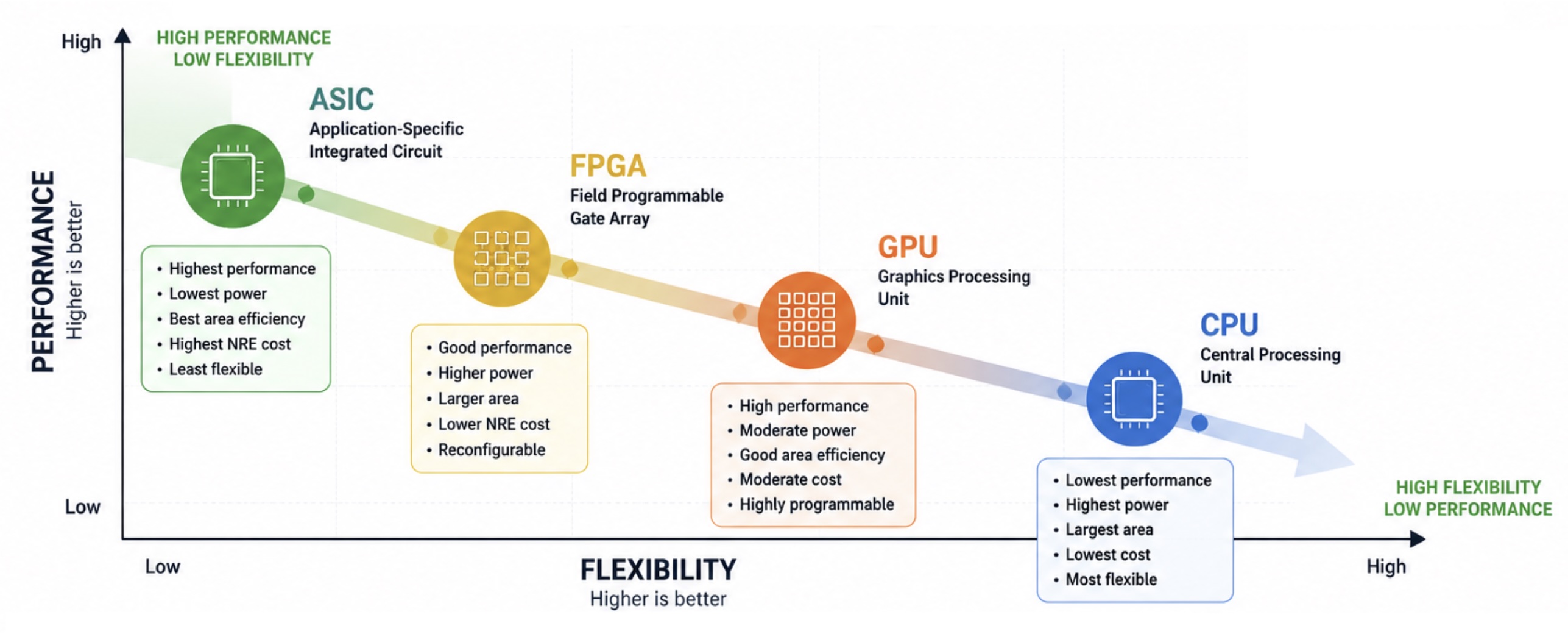
Software running on a general-purpose Central Processing Unit (CPU) offers the greatest flexibility. Almost anything can be changed with an update, but specialized workloads often suffer from lower performance and higher energy consumption.
Graphics Processing Units (GPUs) move one step toward specialization. While still highly programmable, they achieve significantly better performance and efficiency for massively parallel tasks such as AI.
Reconfigurable platforms such as Field Programmable Gate Arrays (FPGAs) and the emerging Coarse-Grained Reconfigurable Architectures (CGRAs) occupy the middle ground. They can be tailored to specific applications while retaining some flexibility after deployment.
At the opposite end sits custom silicon. A dedicated accelerator can be optimized for a specific workload and deliver orders-of-magnitude improvements in performance per watt. The price is reduced flexibility.
Consider AI inference. A neural network running on a CPU may consume tens or hundreds of watts. GPUs improve throughput through parallelism, while reconfigurable hardware can further optimize the computation. A dedicated application-specific integrated circuit (ASIC) can reduce energy consumption by another order of magnitude while simultaneously increasing throughput.
The exact numbers vary by application, but the trend is universal: the more specialized the hardware, the greater the efficiency. This is why modern smartphones, satellites, AI accelerators and autonomous systems increasingly rely on dedicated silicon for their most demanding workloads.
The Cost of Being Wrong
Once silicon becomes permanent, mistakes become extraordinarily expensive.
In software, a bug often leads to an update. In semiconductors, a bug discovered after manufacturing can trigger a redesign, a new tape-out, a new production run and months of delay. For a modern chip, a single silicon revision can cost millions of euros and add three to nine months to a development program.
This reality shapes the entire industry. Semiconductor teams invest enormous effort in simulation, testing and validation before manufacturing ever begins. The objective is not simply to build a chip that works, but to gain confidence that it will continue to work under millions of different operating conditions once it becomes physical.
The consequences extend far beyond engineering costs. Delayed products can miss market windows, postpone customer deployments and consume valuable investment capital. As requirements, technologies and customer expectations evolve, a product that arrives too late may no longer solve the problem it was originally designed for.
Semiconductor companies are not cautious because they lack ambition. They are cautious because the cost of being wrong is exceptionally high.
One Difference Explains Everything
At first glance, software and semiconductors seem similar. Both are products of digital engineering. Both require talented teams, advanced tools and years of accumulated knowledge.
Yet one key distinction changes everything: software can be modified after deployment, while silicon largely cannot.
Verification, development timelines, engineering costs, risk management and product strategies all stem from this single fact. Understanding it is the first step toward understanding the semiconductor industry itself.
And yet, despite the cost, complexity and long development cycles, companies continue to invest billions into semiconductor innovation.
The reason is simple: when software reaches the limits of what general-purpose hardware can deliver, new capabilities become possible only through better hardware. Every major computing revolution—from smartphones and cloud computing to artificial intelligence and autonomous systems—has ultimately been enabled by advances in semiconductor technology.
What’s Next?
If silicon cannot be easily changed after manufacturing, a natural question follows:
How do engineers gain confidence that a design containing billions of transistors will actually work?
In the next article, we’ll explore why verification often consumes more effort than design itself, and why finding bugs before manufacturing is worth millions.
Next article: Where Do Semiconductor Teams Actually Spend Their Time?
© 2026 Polski Krzem PSA